
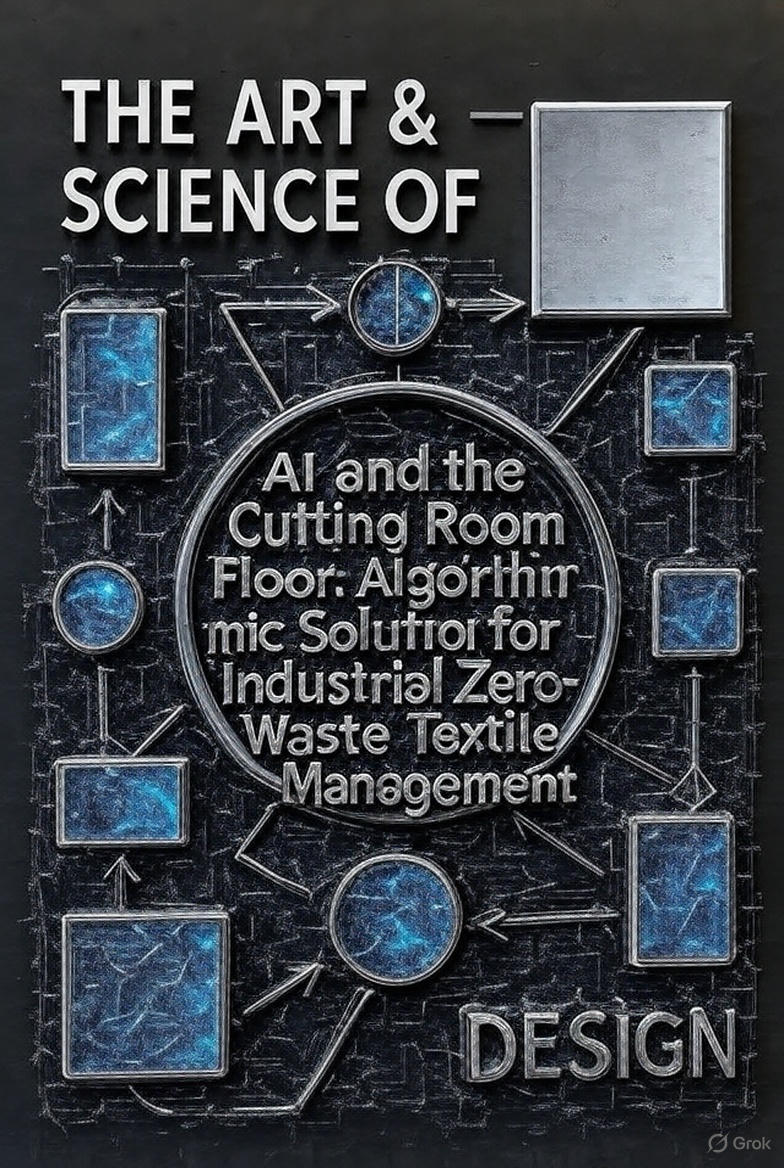
The textile industry’s cutting process is the single largest source of pre-consumer fabric waste, often leaving behind “end-of-roll” and “nesting” waste amounting to 15-20% of the total fabric purchased. While the theoretical concept of Zero-Waste Pattern Cutting (ZWPC) exists, the geometric complexity of manually achieving it for high-volume, multi-size industrial production is insurmountable.
The new frontier is the application of Artificial Intelligence (AI) and Machine Learning (ML) algorithms to solve the NP-Hard “Nesting Problem” at scale. These algorithms, often integrated into sophisticated CAD/CAM systems, use computational geometry to optimize the arrangement of thousands of graded pattern pieces onto a finite piece of fabric (the marker).
The Role of AI in Waste Reduction:
Iterative Optimization: AI algorithms can run millions of potential nesting arrangements in a fraction of the time a human can, identifying global optimal solutions that minimize the interstitial gap (fabric waste) between pattern pieces, pushing utilization rates toward 98-99%.
Irregular Shapes and Remnants: The most advanced systems can take into account irregular fabric shapes—such as leather hides or salvaged remnants—and optimize the pattern layout on these non-rectangular boundaries, recovering material that would have been instantly discarded.
Dynamic Scheduling: Coupled with on-demand manufacturing and Micro-Factory models, AI can create single-layer cutting markers based on real-time, variable order queues, eliminating the traditional practice of large-batch, multi-layer cutting that necessitates greater buffer margins and higher waste.
“Fashion is where imagination takes form — a place where creativity meets craftsmanship. Every stitch tells a story, whispered through texture, color, and shape. My designs are born from emotion, guided by intuition, and finished with purpose.”
Moontaha Ahmed Mridula
Fashion Design Intern,Bangladesh
By treating the cutting process as an optimization challenge, AI transforms an unavoidable waste stream into a recoverable resource. This is a critical technological step toward lean manufacturing in textiles, saving millions of dollars in material costs annually for major brands, while simultaneously addressing the industry’s ethical and environmental mandate to conserve resources.
AI-driven nesting algorithms calculate the most efficient fabric layouts, maximizing yield from every roll of material.
Through predictive analytics, cutting patterns are continuously refined based on real-time production feedback.
This closed-loop intelligence reduces offcuts, energy consumption, and manual adjustments on the factory floor.
Digital traceability ensures every meter of fabric is accounted for, reinforcing transparency and accountability.
As machine learning models evolve, optimization becomes increasingly autonomous and adaptive to new materials.
Ultimately, these advancements redefine waste — transforming it from a cost center into a catalyst for circular innovation.
Would you like me to make the next section focus on AI’s role in circular fashion systems or the human–machine collaboration in design and production?
